
When Your Engine Stutters, Here's What's Actually Going On
Engine misfire diagnosis is the process of identifying why one or more cylinders fail to complete a proper combustion event — and the most common causes, ranked by likelihood, are:
- Ignition system failure (spark plugs, coils, wires) — responsible for roughly 80% of misfires
- Fuel delivery problems (clogged injectors, low fuel pressure)
- Air intake issues (vacuum leaks, dirty MAF sensor, clogged air filter)
- Mechanical failures (low compression, timing issues) — about 15% of cases
A misfire happens when a cylinder doesn't get the right mix of air, fuel, spark, and compression at the right moment. Miss any one of those four, and combustion fails. You need a professional Austin mechanic to help.
You'll feel it — a rough idle, a sudden shudder, a loss of power, or a check engine light that won't quit. Your fuel economy can drop 15–30% almost overnight.
The good news? Misfires follow patterns. And those patterns point directly to the cause — if you know how to read them.
That's where professional diagnosis makes all the difference. A trained technician doesn't just swap parts and hope for the best. They use scan tools, lab scopes, and systematic testing to find the real problem the first time — saving you money and protecting your engine from further damage.
Understanding the Mechanics of an Engine Misfire
To truly understand engine misfire diagnosis, we have to look at the engine as a perfectly timed orchestra. Every cylinder must "hit its note" at exactly the right microsecond. When a cylinder misfires, it means that specific "musician" missed their cue.
The Engine Control Module (ECM) is the conductor. It doesn't actually "see" the spark or "feel" the fuel; instead, it monitors the crankshaft position sensor. By measuring the speed of the crankshaft, the ECM can detect tiny variations. If a cylinder fails to fire, the crankshaft doesn't accelerate as it should during that power stroke. The ECM notices this "stutter" in speed and logs a misfire count.
One of the most immediate casualties of a misfire is your wallet. When a cylinder fails, your engine loses efficiency, and the remaining cylinders have to work harder to compensate. This leads to Hidden Engine Issues That Are Killing Your Fuel Economy, often resulting in a 15% to 30% drop in MPG. Furthermore, if you notice the car struggling more in the morning, you might be dealing with issues explained in Why Your Car Takes Longer to Start on Cold Mornings, which can often be the precursor to a full-blown misfire.
Identifying Symptoms and Early Warning Signs
A misfire isn't always a dramatic event. Sometimes it’s a subtle "hiccup" while you’re waiting at a red light in Buda. Other times, it’s a violent shaking that makes the steering wheel vibrate in your hands. Common symptoms include:
- Rough Idling: The car feels like it wants to stall or "hunts" for the correct RPM.
- Hesitation: When you step on the gas to merge onto the highway, the car stumbles before finally accelerating.
- Vibrations: A rhythmic shaking that matches the engine speed.
- The Flashing Check Engine Light: This is the most urgent sign. A flashing light indicates a "Type A" misfire, which is severe enough to damage your catalytic converter within minutes.
If you see that light, you may wonder, Is My Car Safe to Drive with a Check Engine Light? The short answer is: if it's flashing, pull over immediately.
The Impact of Misfires on Vehicle Longevity
Ignoring a misfire is a recipe for an expensive repair bill. When a cylinder misfires, unburned fuel is pushed out of the exhaust valve. This raw gasoline travels down to the catalytic converter—which operates at incredibly high temperatures—and literally begins to melt the internal ceramic structure. Replacing a catalytic converter can cost anywhere from $1,000 to $2,500, a far cry from the cost of a simple spark plug.
Beyond the exhaust, misfires cause fuel dilution in your oil. Raw gas washes down the cylinder walls, removing the lubricating oil film and leading to premature wear on piston rings and bearings. As noted in Engine Misfires: Diagnose and Repair | O'Reilly Auto Parts, maintaining the balance of air, fuel, and spark is essential for the long-term health of your vehicle.
Professional Engine Misfire Diagnosis: Beyond the Check Engine Light
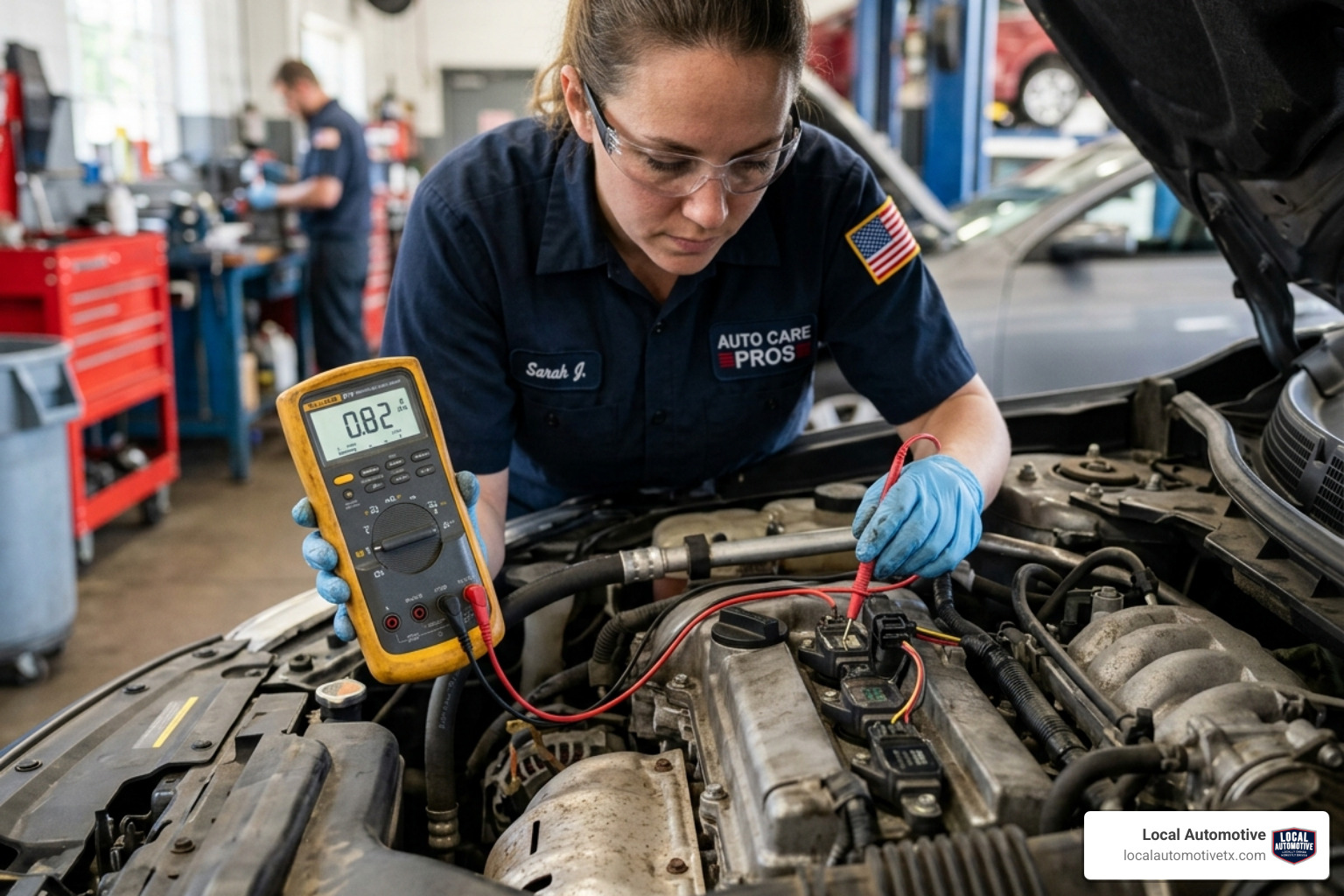
While a cheap code reader from the internet might tell you "P0303," it doesn't tell you why cylinder three is unhappy. Professional engine misfire diagnosis involves a deep dive into the engine's "brain" and its electrical health. At Local Automotive, we look at Engine Performance as a whole system rather than just a list of codes.
A professional diagnostic strategy involves looking at "Freeze Frame" data—a snapshot of exactly what the engine was doing (RPM, temperature, load) the moment the misfire occurred. This helps us replicate the conditions and find the root cause, whether it's a complex electrical fault or a mechanical failure.
Using OBD-II Data for Engine Misfire Diagnosis
Modern vehicles provide a wealth of information through Mode $06 data. This is "behind-the-scenes" information that the ECM uses before it even decides to turn on the check engine light.
- P0300: Indicates a "Random or Multiple" cylinder misfire. This usually points to a system-wide issue like low fuel pressure or a vacuum leak.
- P0301–P0308: These are cylinder-specific. For example, a P0304 means the problem is isolated to cylinder number four.
- Misfire Counters: We can watch live data to see exactly how many times a cylinder misfires per 1,000 revolutions. Even if the car feels "fine," a climbing counter tells us a component is on its way out.
The Role of Lab Scopes in Engine Misfire Diagnosis
When the computer data isn't enough, we use a lab scope (oscilloscope). This tool allows us to see electricity in real-time. By "scoping" an ignition coil, we can see the "firing line" (the voltage needed to jump the spark plug gap) and the "burn line" (how long the spark actually lasted).
A spark duration of under 0.75ms often indicates a lean mixture, while a line over 2ms might suggest a rich condition. We can even see "oscillations" at the end of the spark—if those are missing, the coil itself is likely shorted internally. This level of detail is something no DIY "parts swap" can match.
Why Professional Testing Beats the "Parts Cannon"
The "Parts Cannon" is a common term for buying parts and throwing them at the car until it’s fixed. This is expensive and frustrating. Professional testing uses systematic elimination. We check for pulsed grounds at the injector and verify wiring integrity before recommending a part.
| Diagnostic Method | DIY "Parts Swapping" | Professional Diagnosis |
|---|---|---|
| Accuracy | Low (Guesswork) | High (Data-Driven) |
| Cost | High (Buying unnecessary parts) | Lower (Fix it once, fix it right) |
| Time | Days of trial and error | Hours of precise testing |
| Risk | High (Potential for further damage) | Low (Safe, verified procedures) |
Common Culprits: Spark, Fuel, and Air Imbalances
When we get into the "nitty-gritty" of Engine Repair, we usually find the culprit in one of three areas: Spark, Fuel, or Air.
Ignition System Failures
Statistically, 80% of misfires live here. Modern ignition coils can generate up to 40,000 volts to bridge the gap of a spark plug. Over time, that gap widens as the metal erodes.
- Spark Plugs: Standard copper plugs might last 30,000 miles, but high-end Iridium plugs can go 100,000 miles. However, even Iridium plugs can fail early if the engine is running poorly.
- Ignition Coils: These often fail due to heat soak or because they are "overworked" by worn-out spark plugs.
- Boot Leaks: Sometimes the rubber boot on the coil develops a tiny crack. The 40,000 volts will take the path of least resistance, "arcing" to the engine block instead of going through the plug.
Fuel Delivery and Air Intake Obstructions
If the spark is strong, we look at the "chow" the engine is eating.
- Fuel Pressure: Most gasoline engines need between 30 and 80 PSI. If the pump is weak, the engine starves under load.
- Clogged Injectors: Think of a fuel injector like a fine misting nozzle. If it gets clogged with deposits, it’s like "trying to drink a thick milkshake through a coffee stirrer."
- Vacuum Leaks: If "unmetered" air enters the engine through a cracked hose, the air-fuel ratio (ideally 14.7:1) gets thrown off, causing a lean misfire.
- MAF Sensors: The Mass Air Flow sensor tells the computer how much air is coming in. If it's dirty, the computer "lies" to the injectors, and the engine stumbles.
Interpreting Spark Plug Condition
We can "read" a spark plug like a doctor reads an X-ray.
- Tan/Gray: A healthy, well-burning cylinder.
- Black Sooty: A "rich" condition—too much fuel or not enough air.
- White/Blistered: A "lean" condition—too much air or not enough fuel, causing the plug to overheat.
- Wet/Oily: This indicates oil is entering the combustion chamber, usually from bad valve seals or piston rings.
Advanced Testing for Mechanical and Intermittent Issues
Sometimes, the spark and fuel are perfect, but the "container" is broken. This is where we move into Engine Repair for mechanical integrity.
Compression and Leak-Down Testing
Every cylinder needs to squeeze the air-fuel mixture to make power. Most healthy engines should show between 125 and 200 PSI. If one cylinder is more than 10% lower than the others, it won't produce enough power, resulting in a misfire. A Leak-Down Test is even more precise. We fill the cylinder with compressed air while it’s at the top of its stroke. If air hisses out the tailpipe, an exhaust valve isn't seating. If it bubbles in the radiator, you likely have a blown head gasket.
Vacuum Gauge and O2 Sensor Waveform Analysis
A simple vacuum gauge is a "window" into the engine's soul. A steady needle between 18 and 21 in./Hg at idle indicates a healthy engine. If the needle flickers, it might mean a chipped valve. We also analyze O2 sensor hash. When a cylinder misfires, it sends raw oxygen into the exhaust. The O2 sensor sees this and creates "hash" or rapid spikes in the voltage signal. This helps us identify which "bank" of the engine is having trouble, even if the misfire is intermittent.
Identifying Intermittent and Heat-Related Misfires
The most frustrating misfires are the ones that only happen "sometimes." These are often heat-related. As the engine warms up, metal and plastic expand. A tiny crack in an ignition coil might only open up once the engine reaches operating temperature. Similarly, a wiring harness might have an intermittent short that only occurs when you hit a bump or when the engine shifts under heavy load.
Frequently Asked Questions about Engine Misfires
Why does my car misfire only when the engine is cold?
Cold engines require a richer fuel mixture to stay running. If you have a marginal spark plug or a tiny intake manifold gasket leak, it might show up only when cold. Once the engine warms up and the parts expand, the leak might seal itself, or the plug might find its "rhythm." This is often linked to the same culprits that cause your car to take longer to start on cold mornings.
Can a misfire damage my catalytic converter?
Yes, and quickly. A misfire sends unburned fuel into the exhaust. This fuel ignites inside the catalytic converter, which can reach temperatures over 1,200 degrees Fahrenheit. This causes the internal honeycomb to melt or shatter. If your check engine light is flashing, you are in the "catalyst-damaging" zone.
How much does a misfire affect my fuel economy?
Expect a drop of 15% to 30%. Because one cylinder isn't contributing, you have to push the gas pedal down further to maintain speed. This throws off the stoichiometric ratio (the perfect 14.7:1 air-to-fuel balance), leading to hidden engine issues that kill your fuel economy.
Get Engine Help Today!
At Local Automotive, we know that a stuttering engine can be stressful. Serving our neighbors in Buda and throughout Hays County, we are committed to providing honest, transparent, and reliable Austin engine repair. We don't believe in the "parts cannon"—we believe in using the right tools and the right data to get you back on the road safely
Don't let a small stutter turn into a multi-thousand-dollar repair. If your car is acting up, bring it to a team that values community and straightforward dealings.
Ready to stop the stutter? Visit our shop for fast and friendly https://localautomotivetx.com/contact-us/auto diagnostics in Austin TX. We'll make sure your engine's ""orchestra"" is playing in perfect harmony.