
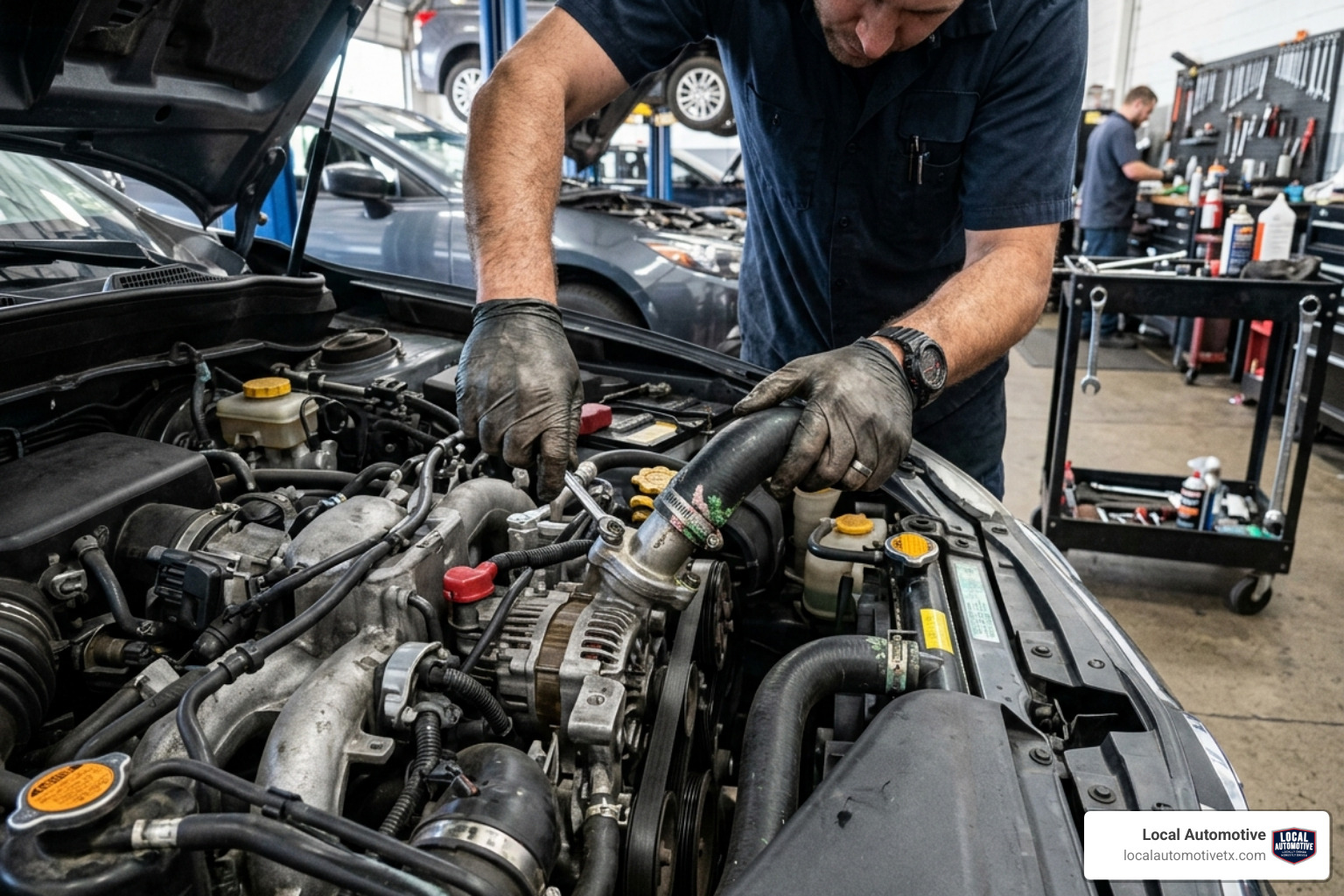
To understand why you might need car heating repair, it helps to realize that your car doesn't actually have a ""heater"" in the way your home does. There is no electric coil or gas flame warming the air. Instead, your car is a master of recycling, and regular checks such as a Buda battery test can help ensure every system, including your heater, is ready when you need it.
The heart of the system is the heater core. Think of the heater core as a miniature radiator hidden deep behind your dashboard. While the big radiator at the front of your car sheds engine heat into the atmosphere to keep the motor cool, the heater core sheds that same heat into the cabin to keep you warm.
Here is the step-by-step cycle of how that warmth reaches your toes:
- Heat Generation: As your engine runs, it creates immense heat. The engine coolant (a mix of water and antifreeze) circulates through the engine block to soak up that heat.
- Circulation: A water pump pushes this hot fluid through rubber heater hoses toward the dashboard.
- Regulation: The thermostat acts as a gatekeeper. It stays closed until the engine reaches a specific temperature, ensuring the car warms up quickly before allowing the hot coolant to flow freely.
- Heat Exchange: The hot coolant enters the heater core. A blower motor (essentially a high-powered fan) blows air across the fins of the heater core.
- Distribution: The air picks up the heat from the core and is directed through vents by blend doors to your face, feet, or windshield.
According to 1A Auto, if any part of this ""hot potato"" hand-off fails—whether it's a lack of fluid or a stuck gate—you’ll be left shivering, and you'll likely need expert car repair in Buda to get everything working again.
Common Causes for Car Heating Repair
When we see vehicles at Local Automotive for heater issues, we usually find the culprit in the cooling system. Since the heater relies on engine heat, any disruption in the cooling loop means no warmth for the driver.
Low Coolant Levels
This is the most frequent cause of car heating repair requests. If your coolant is low, the engine will prioritize its own safety first. It will keep what little fluid is left inside the engine block to prevent a meltdown, leaving the heater core dry. If you notice your heater works while you're driving but blows cold air when you're stopped at a red light on FM 1626, low coolant is the likely suspect.
Stuck Thermostat
The thermostat is a small but mighty component. If it gets stuck in the "open" position, coolant flows through the radiator constantly, never allowing the engine to get hot enough to provide cabin heat. If it's stuck "closed," your car will overheat rapidly, which is a much more dangerous situation.
Water Pump and Control Valves
The water pump is the "heart" that pumps the lifeblood (coolant) through the system. If the pump's internal vanes are worn, it won't have the pressure to push hot fluid into the heater core. Some vehicles also use a heater control valve that acts like a faucet; if it stays shut, the heat stays out.
Air Pockets
Sometimes, after a cooling system service, air can get trapped in the lines. These "air locks" act like a wall, preventing hot coolant from entering the heater core. This often requires a professional "bleeding" of the system to ensure all air is purged.
Identifying a Failing Heater Core
The heater core is one of the more labor-intensive parts to replace because of its location. You can find more details on how these failures affect your visibility in our guide on Troubleshooting Your Defroster System.
Watch for these specific red flags:
- A sweet, syrupy smell: Antifreeze has a distinct "candy-like" odor. If you smell it inside the car, the core is likely seeping.
- Foggy windows: A leaking core sprays a fine mist of coolant onto the inside of the glass, creating a greasy film that is nearly impossible to wipe away.
- Wet floorboards: If the passenger-side carpet feels damp or slimy, the heater core is literally leaking into your cabin.
When to Suspect a Blend Door or Actuator Issue
If your engine is hot and the hoses going into the dashboard are hot, but the air is still cold, the problem is likely "mechanical" rather than "fluid-based."
Modern cars use blend doors—small plastic flaps—to mix hot and cold air. These are moved by small electric motors called actuators. If you hear a repetitive "clicking" or "thumping" sound behind the dash when you change the temperature, an actuator has likely stripped its gears. In dual-zone systems, you might even have the passenger side blowing hot while the driver side stays freezing.
Why Professional Car Heating Repair Saves You Money
It might be tempting to start buying parts and swapping them out, but professional car heating repair is almost always the cheaper route in the long run. At Local Automotive, we focus on "test, don't guess."
Diagnostic Accuracy
A "no heat" symptom could be a $20 fuse or a $1,000 heater core. Without specialized tools like thermal imagers and OBD-II scanners that can "talk" to your car's climate computer, it's easy to misdiagnose the problem. We use advanced scanners to see exactly what the sensors are seeing, ensuring we only replace what is actually broken.
Avoiding the "Parts Cannon"
We’ve seen many well-meaning owners spend hundreds of dollars on new radiators and water pumps, only to find out the problem was a $150 blend door actuator. By bringing your car to a professional shop, you leverage our expertise and specialized air conditioning and heating services to get the job done right the first time.
The Risks of DIY Car Heating Repair
While we love a good project, the car's heating system is not the place for beginners.
- Pressurized Burns: Opening a radiator cap or pulling a heater hose on a warm engine can result in 200-degree fluid spraying onto your skin.
- Dashboard Disassembly: Replacing a heater core often requires removing the entire dashboard—steering column, airbags, and all. This can take 10 to 12 hours of labor and requires extreme precision to avoid "rattles" or electrical shorts later on.
- Environmental Concerns: Coolant is toxic to pets and the environment; professionals have the equipment to catch, recycle, and dispose of it safely.
Preventive Maintenance to Avoid Costly Repairs
The best way to save money on car heating repair is to make sure you never need it. Most heater failures are the result of "old age" in the fluid.
- Coolant Flushes: Over time, antifreeze becomes acidic and begins to eat away at the aluminum inside your heater core. It also develops "sludge" that can clog the tiny passages in the core. A regular flush (usually every 30,000 to 50,000 miles) keeps the system clean and prevents clogs.
- Hose Inspections: Rubber doesn't last forever. Our technicians check for "soft spots" or "crunchy" textures in your heater hoses during every oil change.
- Cabin Air Filters: A clogged filter restricts airflow. If your heater feels weak, it might just be that the fan can't pull enough air through a dirty filter.
- Seasonal Testing: Don't wait for the first freeze in Hays County to turn on your heater. Test it in October! Running the system periodically keeps the seals lubricated and ensures the blend doors don't "stick" from disuse.
For more tips on getting your car ready for the cold, check out our article on why your car heater isn’t working and how to fix it before the holidays.
Frequently Asked Questions about Car Heating Repair
| Component | Estimated Repair Cost | Typical Timeframe |
|---|---|---|
| Thermostat Replacement | $150 – $400 | 1 – 2 Hours |
| Coolant Flush & Fill | $100 – $200 | 1 Hour |
| Blower Motor | $250 – $600 | 1 – 2 Hours |
| Blend Door Actuator | $200 – $500 | 2 – 4 Hours |
| Heater Core Replacement | $800 – $1,800+ | 8 – 12 Hours |
Why is my car heater blowing cold air?
As mentioned, the most likely culprit is low coolant. However, it could also be a thermostat stuck open (preventing the engine from warming up) or a clogged heater core that isn't letting the hot fluid pass through.
How much does car heater repair typically cost?
According to Jerry, costs vary wildly. A simple fuse or relay might be under $50, while a heater core is the most expensive due to the immense amount of labor required to "strip" the interior of the car to reach it.
Is it safe to drive without a working heater?
In the short term, if you can see out of the windshield, it is ""safe"" but uncomfortable. However, if your heater isn't working because of a cooling system leak, your engine is at risk of a catastrophic overheat. If you cannot defrost your windshield, it's illegal and dangerous to drive due to lack of visibility.
How to Get Your AC Fixed Fast!
At Local Automotive, we believe in keeping our neighbors throughout Hays County safe and comfortable. Car heating repair doesn't have to be a headache or a financial burden if you catch the issues early. Whether it’s a simple coolant top-off or a complex actuator replacement, we provide honest diagnostics and transparent pricing with no hidden surprises.
Don't spend another cold morning shivering behind the wheel. Our auto shop in Buda TX is committed to community values and straightforward dealings, ensuring your vehicle is ready for whatever weather Texas throws our way.
Ready to get your cabin toasty again? Schedule your professional car heating repair with Local Automotive today.