
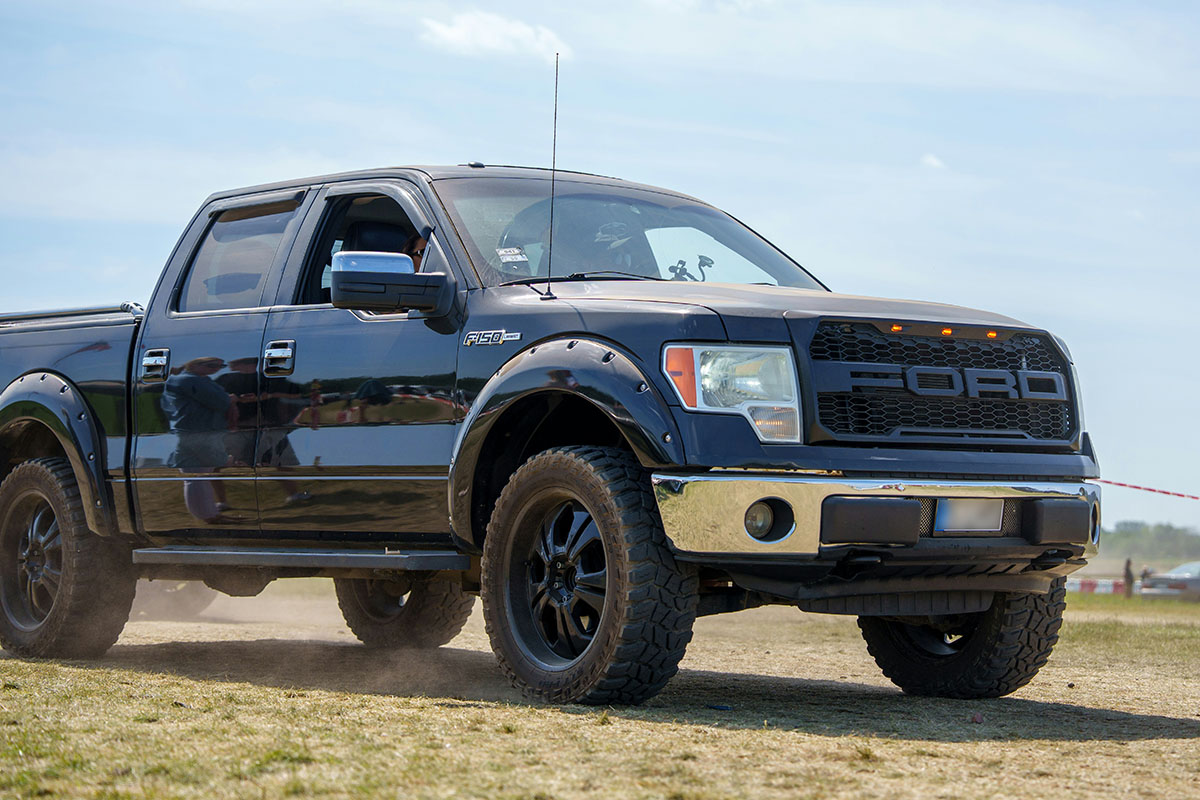
The F-150 has been the best-selling vehicle in America for over 40 consecutive years, not because of marketing, but because it works. People buy it to haul, tow, and get things done. Which makes it especially unsettling when it develops an unexplained shudder during normal driving.
It usually shows up during light acceleration, a brief vibration, like driving over rumble strips for two or three seconds. The instinct is to assume the worst: bad torque converter, failing clutch packs, a $3,000 repair. In most cases, the transmission itself is fine. The fluid inside it isn't, which is why you should see a Buda mechanic.
What is Causing That Shudder? The Science Behind the Shake
The shudder traces back to the torque converter clutch. Your automatic transmission uses a torque converter as a fluid coupling between the engine and the gearbox. At cruising speeds, a clutch inside that converter locks up to create a direct mechanical connection, eliminating the slippage that wastes fuel at highway speeds.
When the lockup isn't smooth, when the clutch applies and releases in rapid, uncontrolled cycles, you feel it as a shudder. The most common reason this happens is degraded Automatic Transmission Fluid (ATF).
ATF isn't just a lubricant. It also acts as a coolant, a hydraulic fluid, and, most relevant here, it carries friction modifiers, chemical additives that allow the torque converter clutch to engage cleanly instead of chattering. Heat is what kills those additives. Run the truck hard enough, long enough, and the modifiers break down.
Texas Heat and Traffic: A Transmission's Worst Enemy
Transmission fluid runs around 175°F under normal highway conditions. Towing a loaded trailer can push that past 250°F. Stop-and-go traffic on the Mopac Expressway does the same thing, heat builds every time you brake and inch forward. Above certain temperatures, the friction modifiers in ATF start degrading, and once they're gone, topping off the fluid doesn't restore them.
Once those friction properties degrade, the torque converter clutch can't grab cleanly. It slips and chatters instead of locking. That's the shudder. The transmission itself isn't necessarily failing, the fluid is.
The Solution: A Fluid Flush, Not Just a "Drain and Fill"
If the fluid is the problem, changing it is the fix. But a standard drain-and-fill, where you drop the pan plug and swap a few quarts, only replaces roughly 30-40% of the total fluid volume. The rest stays trapped in the torque converter, valve body, and cooler lines. You're diluting the old fluid with new, not replacing it.
The right fix is a transmission fluid exchange, not a drain-and-fill. Specialized equipment attaches to the transmission cooler lines and uses the transmission's own pump to displace the old fluid while new ATF flows in simultaneously. Done correctly, this replaces roughly 90-95% of the fluid volume, compared to about 30-40% with a basic drain-and-fill. For 2011-2019 F-150s with the 6R80 transmission, the replacement fluid must meet Ford's Mercon LV specification. Using the wrong viscosity or friction modifier package doesn't just fail to fix the shudder, it can make it worse.
When a Fluid Change Isn't Enough
A fluid exchange solves the shudder when the fluid is the problem: degraded friction modifiers causing the torque converter clutch to chatter rather than engage cleanly. But if the shudder has been running for 20,000 miles or more without attention, the friction material on the TCC may have worn past its service limit. At that point, the fluid has nothing left to work with. The torque converter needs to come out, a $600-$1,200 job at most independent shops, more at a dealership.
Metal shavings in the transmission pan change the diagnosis entirely. That's not a fluid problem, that's a gear or bearing already shedding material, and a fluid exchange won't stop the damage. At that point, you're looking at a rebuild or replacement: $2,500-$4,500 depending on whether you go remanufactured or new. The cost gap between catching a shudder early (a $150-$250 fluid service) and catching it late (a $3,000+ rebuild) is exactly why transmission shops push maintenance intervals so hard.
The Business Perspective: Minimizing Downtime
For fleet managers running F-150s, a shuddering truck creates two problems: the repair bill and the downtime. An unplanned transmission service can pull a vehicle for two to three days during a busy period. Scheduling fluid inspections every 30,000 miles, or annually for high-mileage commercial use, catches degraded fluid before it reaches the shudder stage. Pairing that with spark plug interval checks is worth doing: the 6R80 shudder and cylinder misfire symptoms overlap enough that misdiagnoses are common, and chasing the wrong cause wastes both time and money.
The most cost-effective intervention is driver reporting. A shudder caught early is a fluid service. The same shudder ignored for 10,000 miles may mean a torque converter. Brief drivers on what to watch for, a rhythmic vibration between 40 and 50 mph that disappears when you manually downshift, and set a clear reporting threshold. That one conversation can be the difference between a $200 service call and pulling a truck from rotation for a week.
FAQs
Can I use a shudder-fix additive to solve the problem?
Products like Lubegard Shudder Stop can quiet the shudder temporarily by altering the fluid's friction coefficient, and some Ford techs use them as a short-term diagnostic tool to confirm the shudder is TCC-related before recommending a full fluid exchange. The problem is that they don't remove the degraded fluid, the friction debris, or the burnt residue, they mask the symptom. A full fluid exchange with Mercon LV-spec fluid is the actual repair. If an additive stops the shudder, treat that as confirmation the fluid is the cause, then do the fluid exchange.
How can I tell if my shudder is an engine misfire?
Watch when the vibration occurs. TCC shudder typically shows up between 40 and 50 mph at light throttle in 6th gear, when engine RPM sits around 1,200-1,500. Press the Tow/Haul button or manually downshift, if the shudder stops as RPM climbs past 1,800, the torque converter is the likely cause. A misfire doesn't care what gear you're in; it shows up across the RPM range and usually throws a P030X code. Pull the OBD-II codes first. If you have a misfire code alongside the shudder, fix the misfire first, it's cheaper and may be the only problem.
Will a transmission flush damage my F-150?
"Flush" means different things at different shops. The kind to avoid on high-mileage units is a high-pressure machine flush that forces solvent or fluid backward through the valve body, that process can dislodge debris and push it into passages that were previously unaffected. What Ford dealers and most transmission specialists recommend instead is a fluid exchange, where new fluid enters through the cooler lines while old fluid exits, driven by the transmission's own pump. On a truck with a documented service history, the distinction matters less. On one with 100,000-plus miles and unknown maintenance records, it matters considerably.
Is the F-150 shudder covered under warranty?
Ford's powertrain warranty runs 5 years or 60,000 miles, whichever comes first. Transmission shudder that falls within that window is typically covered at no cost. The catch: torque converter clutch shudder often doesn't surface until 80,000 miles or beyond, by which point most trucks are well past the warranty cutoff.
Does the F-150 shudder affect fuel economy?
It does. A slipping or unlocked torque converter clutch forces the engine to rev higher than it should to hold speed, that's wasted energy. Owners dealing with this issue commonly report a drop of 1 to 2 MPG, sometimes more depending on driving conditions. Once the shudder is resolved, fuel economy typically returns to baseline.
Is the shudder always a transmission fluid problem?
Degraded transmission fluid is the most common culprit, but not the only one. Engine misfires from worn spark plugs or failing ignition coils can produce a vibration that feels nearly identical under light acceleration. Internal mechanical wear inside the transmission is also possible, though less common than fluid-related causes. That distinction matters, chasing a fluid change won't fix a misfire, and chasing an ignition problem won't fix a worn clutch pack. A proper diagnosis, including a scan for misfire codes and a fluid condition check, narrows it down before anything gets replaced.
My F-150 has the 10-speed transmission. Does it have this problem?
Yes. Ford's 10R80 10-speed, which started appearing in F-150s with the 2017 model year, has generated documented shudder complaints alongside the older 6R80 6-speed. Both transmissions rely on a torque converter lockup clutch, and both use fluid that degrades under sustained heat and load. The failure mode is the same, the clutch can't hold a clean lock, so it slips and shudders. Transmission generation doesn't change the underlying physics.
Ford has a Technical Service Bulletin (TSB) for this issue. What does that mean?
A TSB is Ford's way of telling dealers: "We've seen this before, here's the fix." It's not a recall, so there's no legal obligation for Ford to cover the repair out of warranty, but it does confirm the shudder is a known, recurring issue with a documented solution. For the F-150 shudder, Ford's TSBs, including TSB 18-0039 and related updates, direct technicians to perform a complete transmission fluid exchange using Motorcraft MERCON ULV fluid. Starting with the fluid is the manufacturer's own recommended first step.
Why not just add a friction modifier additive?
A friction modifier bottle is roughly 4 ounces going into 12 quarts of old, contaminated fluid. The degraded fluid doesn't disappear, it's still there, still breaking down clutch material, still carrying the heat and particulates that caused the problem. The additive might quiet the shudder temporarily by nudging the friction coefficient, but it doesn't restore the fluid's viscosity, its heat resistance, or its ability to protect the clutch plates. A full fluid exchange removes the problem. An additive masks it.
From Shudder to Smooth: The Path Forward
That shudder isn't a quirk you learn to live with, it's the torque converter clutch telling you it can't hold a clean lockup. Left alone, a slipping clutch generates heat and wear that compound over time. What starts as a quick fluid change in Buda can escalate into clutch pack replacement or a full rebuild. Caught early, the repair is usually a $150-$250 fluid exchange. Caught late, it can run several thousand dollars. A proper diagnosis tells you exactly where you stand before costs get out of hand.
Don't start replacing parts on a guess. Bring your truck in and let Local Automotive run a proper diagnosis, fluid condition check, misfire scan, road test under load, so any repair targets the actual cause rather than the most likely one. We can perform a transmission repair in Buda to get you back on the road.